
Sustainability is often discussed in terms of what we buy, how much we buy, and what happens to things when we no longer need them.
But there is another part of the conversation that is easy to overlook:
How long do we actually want the things in our home to stay with us?
A beautifully designed object that remains useful and loved for years has a very different relationship with consumption than something bought for a season and forgotten shortly afterwards.
That is where timeless design becomes interesting.
Beyond the Next Trend
Interior trends move quickly.
One year a particular colour is everywhere. The next year, a different material or style takes its place. Social media can make it tempting to constantly update our homes to keep up.
There is nothing wrong with enjoying trends.
But a home does not have to follow every trend to feel beautiful.
Some of the most inviting spaces are built around simple materials, natural textures and objects that do not depend on a particular season to look good.
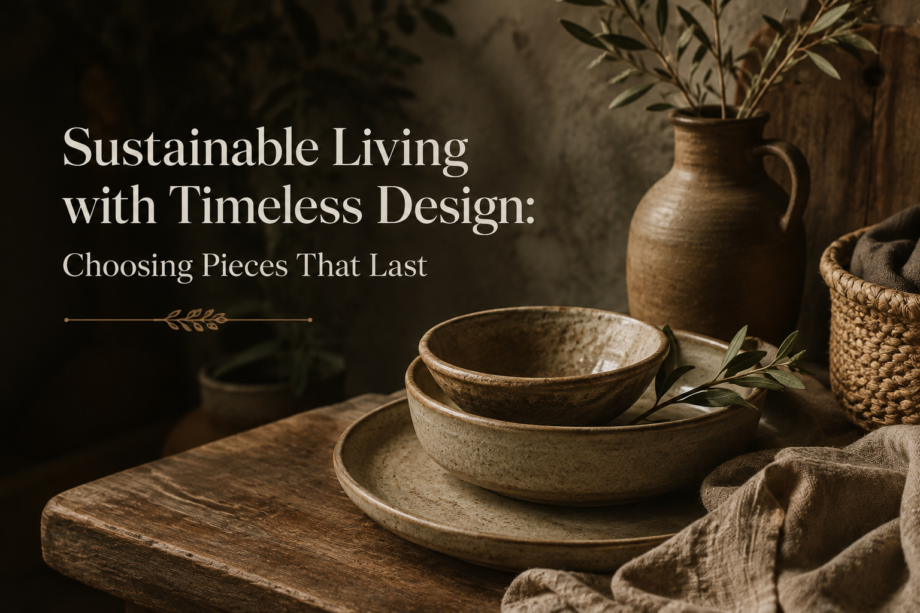
A handmade ceramic piece, a woven textile or a carefully crafted decorative object can often work with different interiors because its appeal comes from its material and character rather than a passing trend.
The Value of Buying With Intention
Sustainable living does not necessarily mean owning nothing.
It can simply mean being more intentional about what we bring into our lives.
Before buying something, it is worth asking a few simple questions:
Do I genuinely like it?
Will I still want it in a few years?
Does it have a useful or meaningful place in my home?
Can it work with the things I already own?
These questions sound simple, but they can change the way we shop.
Instead of buying five decorative pieces because they happen to be popular, we might choose one that genuinely feels right.
Over time, those decisions can create a home that feels more personal.
Natural Materials Have a Different Presence
There is a reason natural materials continue to appear in interior design.
Wood, clay, stone, cotton, linen and woven fibres tend to bring texture into a space. They also interact beautifully with natural light.
A ceramic vase can have tiny variations across its surface. Woven material can reveal the pattern of the hands or tools used to create it. Wood develops character as it ages.
These qualities are difficult to reproduce perfectly because they are part of the material itself.
For a home, that creates something valuable: visual warmth.
Designing for the Long Term
Timeless design does not have to mean traditional design.
A contemporary piece can still be timeless if it avoids unnecessary decoration and focuses on proportion, material and function.
Imagine a neutral room with warm wood, soft fabrics and a single handcrafted object on a shelf.
Five years from now, the object may still work.
Change the wall colour. Move the furniture. Replace the flowers. Rearrange the room.
The piece can remain.
That flexibility is one of the reasons we are interested in objects inspired by heritage but designed to live comfortably in contemporary spaces.
A Home Should Tell Your Story
The best homes rarely look as though everything was purchased on the same afternoon.
They evolve.
A piece might come from a memorable trip. Another might have been passed down through a family. Something else might simply be an object you discovered and loved.
Over time, these things create a visual history.
That is much more interesting than a home that looks exactly like a catalogue page.
At DHUUL, we like the idea that the objects around us should have the opportunity to become part of our stories.
They should be useful, beautiful, and able to remain relevant as our lives change.
Choosing Less, Choosing Better
Sustainable living is not about creating a perfect home.
It is about making better decisions where we can.
Choose quality when it makes sense. Look at materials. Think about how something was made. Consider whether you will still appreciate it after the excitement of a new purchase disappears.
And perhaps most importantly, give yourself permission to buy slowly.
A timeless home is not created overnight.
It develops gradually, through objects that earn their place.