
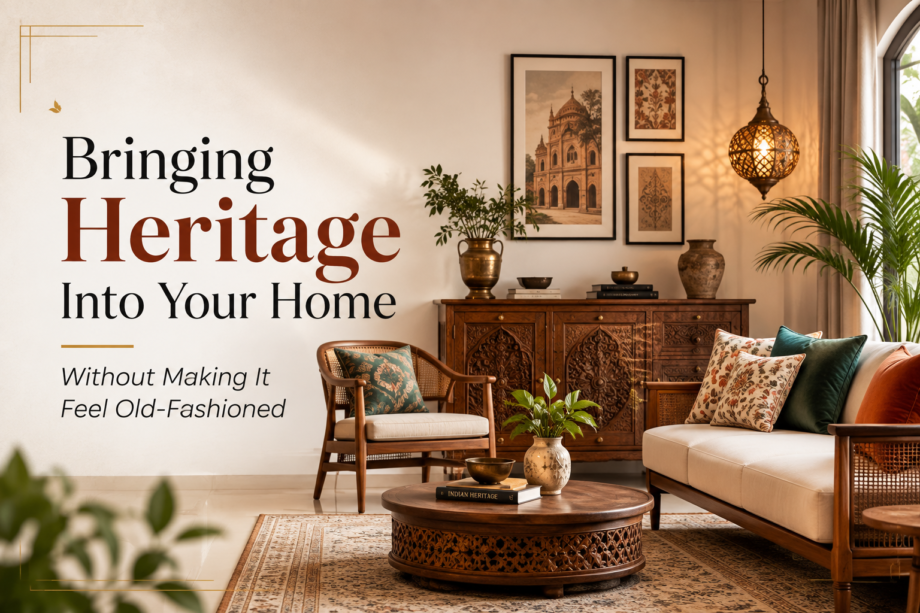
Heritage has a strange relationship with modern interiors.
We love the warmth of old materials, traditional techniques and objects with history, but many of us do not want our homes to feel like a museum.
The good news is that you do not have to choose between the two.
Heritage and contemporary design can work beautifully together.
The key is knowing how to introduce character without overwhelming the space.
Start With One Piece
If you are new to heritage-inspired interiors, there is no need to completely redesign your home.
Start with one object.
A handmade vase on a dining table.
A woven basket beside a chair.
A textured ceramic piece on an open shelf.
One carefully chosen object can change the feeling of a room without changing everything else.
The contrast is often what makes it work.
A traditional-looking texture against a clean modern wall can feel much more interesting than filling the entire room with similar pieces.
Let Texture Do the Talking
One of the easiest ways to introduce a sense of heritage is through texture.
Modern interiors often rely heavily on smooth surfaces: glass, polished stone, painted walls and sleek furniture.
These materials create a clean look, but too many smooth surfaces can sometimes make a room feel flat.
Texture adds depth.
Think of rough ceramic against a smooth wooden table. A woven textile beside a leather chair. A natural fibre basket next to a simple contemporary sofa.
You do not need a lot of colour.
Sometimes texture alone is enough.
Neutral Colours Create Room for Character
Heritage-inspired pieces do not always need strong colours.
In fact, neutral shades can make traditional craftsmanship feel surprisingly contemporary.
Warm beige, natural brown, muted cream, charcoal and soft terracotta can sit comfortably alongside modern interiors.
They also allow the shape and material of an object to become the focus.
This is particularly useful if your home already has a neutral colour palette.
Instead of introducing another bright colour, consider introducing another texture.
The result can feel subtle rather than decorative.
Mix Old Ideas With Modern Spaces
One of the biggest mistakes people make when decorating with heritage-inspired pieces is trying to make everything match.
It does not need to.
A handcrafted object can sit next to a modern lamp.
A traditional textile can work with a minimalist sofa.
A ceramic vessel can sit on a contemporary console.
The contrast creates balance.
Your home should not look as though it belongs to a single period. It should look like a place where different influences have naturally come together.
Think About the Story Behind an Object
There is also an emotional side to heritage.
When we know that a particular object is inspired by a traditional craft or material, we tend to look at it differently.
We notice its texture.
We think about how it was made.
We become curious about the people and traditions behind it.
That curiosity can make an otherwise simple decorative object feel much more meaningful.
For DHUUL, this is an important part of the idea behind the collection.
We are interested in the connection between the past and the way we live now.
Not copying history, but carrying elements of it forward.
Make It Personal
Ultimately, there are no strict rules for bringing heritage into your home.
Your home should reflect you.
If you love minimal interiors, choose one or two pieces with strong texture and let them stand alone.
If your space is already warm and eclectic, you can layer different materials and objects.
If you prefer a clean Scandinavian-inspired interior, a natural ceramic or woven piece can add warmth without changing the overall aesthetic.
The important thing is that the objects feel intentional.
Let Your Home Evolve
Perhaps the most beautiful thing about a home is that it is never really finished.
We move things around. We discover new objects. We change our taste. We keep some things and eventually let others go.
Heritage-inspired design fits naturally into that process because it is less dependent on what happens to be fashionable this year.
A well-made object can move with you.
It can live on a shelf today, become part of a dining table tomorrow, and perhaps one day find its way into another room entirely.
That is what makes timeless pieces special.
They do not demand that your home stay the same.
They simply become part of its story.