
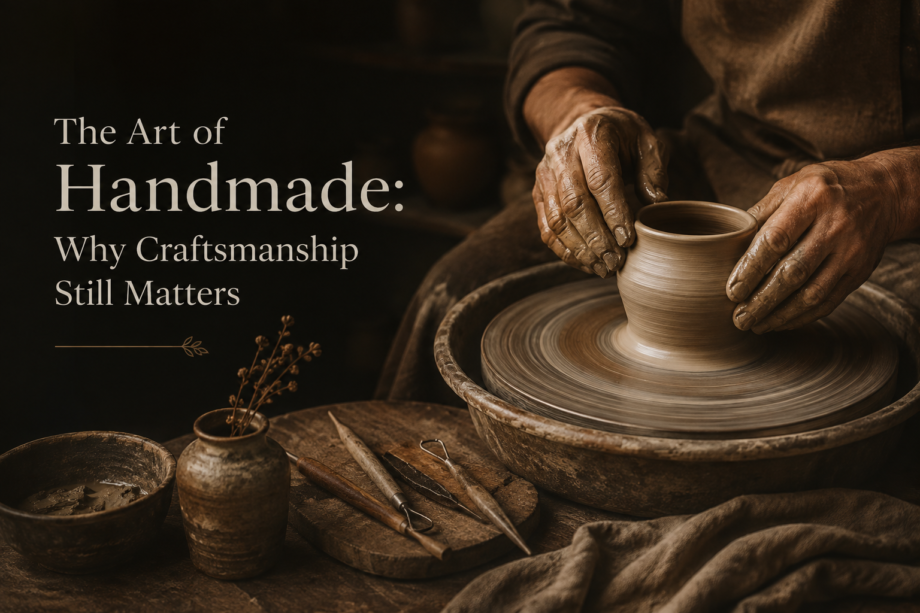
There is something different about an object that has been made by hand.
You notice it before you can always explain why.
Maybe it is a tiny variation in the surface. Perhaps the shape is not perfectly symmetrical, or the texture changes slightly from one side to another. These small details are often what make a handmade piece feel alive.
In a world where so many things are produced to look identical, those imperfections can be surprisingly comforting.
More Than Just an Object
When we buy something for our home, it is easy to think about its practical purpose first. A vase holds flowers. A basket stores things. A textile adds warmth to a room.
But handmade objects can offer something beyond their function.
They carry a sense of the process behind them.
Think about a ceramic vessel. Before it becomes the finished piece sitting on a shelf, it begins as a simple material shaped by someone’s hands. There is patience involved in forming it, adjusting it, letting it dry, and eventually giving it its final character.
That process leaves traces.
And perhaps that is why handmade objects often feel more personal than mass-produced alternatives.
The Beauty of Small Differences
One of the things we appreciate about traditional craftsmanship is that no two handmade pieces need to be completely identical.
A slightly different texture does not necessarily mean something is wrong. A subtle variation in colour can be part of the making process. Even small differences in shape can remind us that a person, rather than a machine alone, was involved.
For modern homes, this can be particularly beautiful.
A room does not have to be filled with traditional furniture or antique objects to have character. Sometimes one carefully chosen handcrafted piece is enough to introduce warmth and personality.
It might sit quietly on a console table, become part of a dining setting, or simply occupy an empty corner where its texture catches the afternoon light.
Bringing Heritage Into Modern Homes
Traditional craft does not have to remain locked in the past.
In fact, some of the most interesting pieces are those that take inspiration from heritage while fitting naturally into contemporary spaces.
Clean interiors can sometimes feel a little too perfect. Handmade textures introduce contrast. Natural materials soften sharper architectural lines. A weathered or tactile surface can make a minimalist room feel less clinical and more lived-in.
This is one of the ideas behind DHUUL.
We are drawn to pieces that feel connected to tradition but do not look out of place in today’s homes. The goal is not to recreate the past exactly. It is to appreciate what was valuable about it and allow those qualities to have a place in modern life.
Why We Should Buy More Thoughtfully
There is also something to be said for buying fewer things and choosing them more carefully.
A home filled with objects purchased simply because they were convenient can quickly become crowded. But when we choose something because we genuinely like its material, story, or character, it tends to mean more.
It is the difference between decorating a room and creating a space.
A handcrafted object can become something you keep for years rather than replace when the next trend arrives.
And perhaps that is the real value of craftsmanship.
Not simply that something was made by hand, but that it encourages us to slow down and appreciate what we bring into our homes.
Keeping Craft Alive
Traditional craftsmanship survives when people continue to value it.
Every purchase of a thoughtfully made object can contribute, in a small way, to keeping certain skills and approaches relevant. It creates space for makers and traditional techniques to remain part of contemporary culture rather than becoming something we only see in museums.
At DHUUL, that connection between heritage and everyday living is at the heart of what we want to explore.
We believe beautiful objects do not need to shout for attention.
Sometimes, the quietest pieces are the ones that stay with us the longest.